Table of Contents
Introduction: The Rise of Laundromat Subscriptions
Laundromat Membership Tiers: The Math Behind Unlimited Wash-Dry-Fold Subscriptions
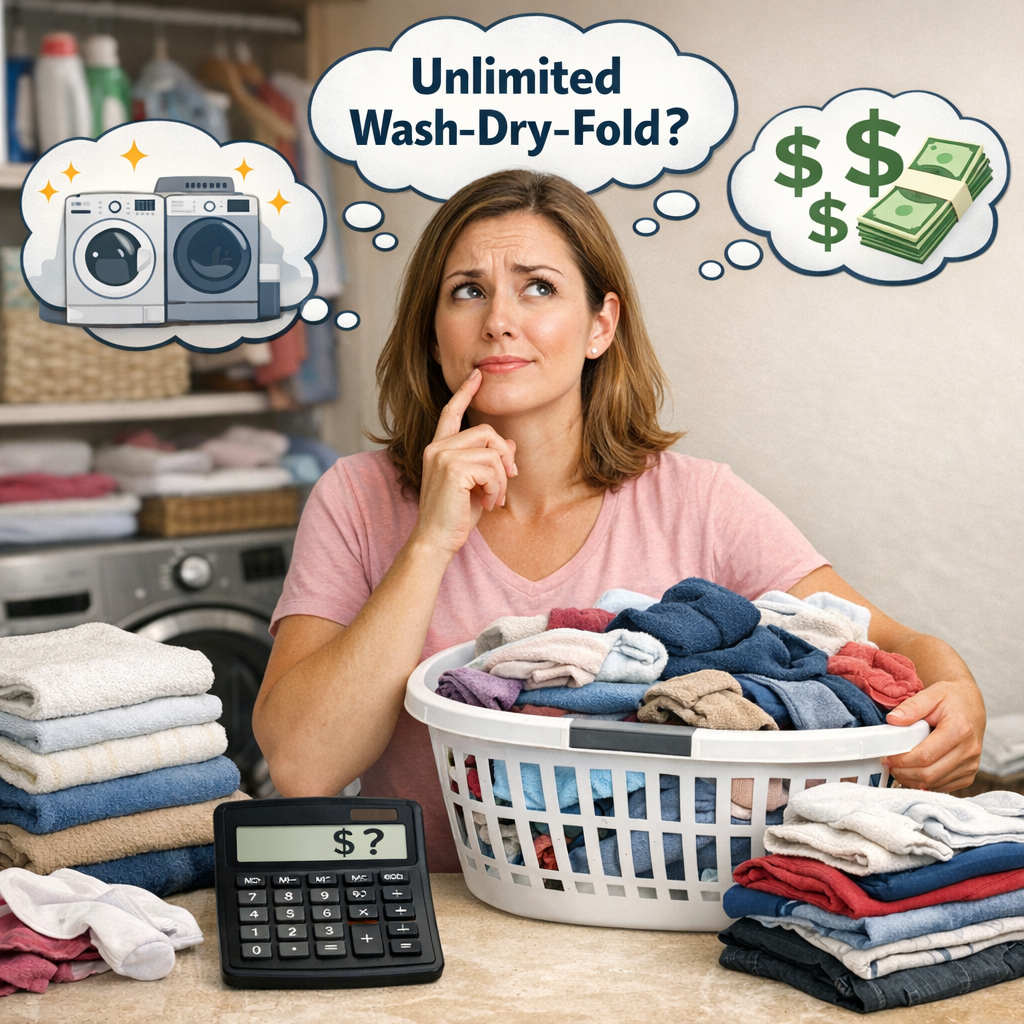
From grocery shopping to laundry services, the subscription model has become an increasingly popular way for consumers to simplify their lives. With laundromats now offering unlimited wash-dry-fold (WDF) packages, it’s time to dive into the math behind these membership tiers and how they benefit both businesses and customers.
- Exploring the benefits of subscription-based laundry services
- An in-depth look at calculating the ‘break-even’ point for a laundry subscription service
- How to ensure you don’t lose money by catering to heavy users
Understanding the Unlimited Wash-Dry-Fold Model
Understanding the Unlimited Wash-Dry-Fold Model
The unlimited wash-dry-fold model is based on a subscription system where customers pay a flat fee for a certain number of cycles, with no additional cost per use. This model aims to provide convenience and cost savings for customers while generating recurring revenue for laundromats.
- Calculating the ‘Break-Even’ Point:
- Determine the number of cycles needed to break even:
- Calculate the revenue generated by each subscription tier:
- Light users: 1 cycle = 2 cycles for heavy users
- Medium users: 1.5 cycles = 3 cycles for heavy users
- Heavy users: 2 cycles = 4 cycles for light/medium users
- Cost per cycle: The cost of washing, drying, and folding one load of laundry.
- Subscription price: The monthly fee charged to customers for unlimited wash-dry-fold services.
- Average usage: The average number of cycles each customer uses per month.
- Customer acquisition cost: The amount spent on marketing and advertising to acquire new customers.
- Cost per cycle = $10
- Subscription price = $30
- Average usage = 3 cycles/month
- Customer acquisition cost (CAC) = $1000
- Machinery and Maintenance: The cost of washing machines, dryers, and folding equipment must be considered. Additionally, maintenance and repair expenses should not be overlooked.
- Utilities: Electricity and water consumption are significant costs for laundry services. These expenses can vary greatly depending on the location and demand for service.
- Detergent: Laundry detergent is another variable cost that can fluctuate based on the type and quantity used. It’s essential to factor in the price of high-quality, eco-friendly detergents if offering such services.
- Labour: Employee salaries or wages must be factored into the calculation. This includes staff who operate machines, assist customers, and perform general cleaning tasks.
- Assumptions: We assume that each machine is used 30 times a month, with an average of 10 loads per visit.
- The cost to operate one washing machine is $30 per month (including water, electricity, detergent, and maintenance).
- Each machine generates $240 in revenue per month ($40 x 6 machines).
- Break-even point: To calculate the break-even point, we need to determine how many machines are needed to cover operating costs. In our example, 3 machines would be necessary ($90 in revenue per month to cover $30 in expenses).
- Profit margin: With 6 machines, CleanSlate generates a profit of $150 per month (12 machines – 6 machines = $240 in revenue – $90 in operating costs), resulting in a profit margin of 62.5%.
- Understanding the math behind these subscriptions is crucial in optimizing membership tiers.
- By balancing pricing and usage data, laundromat owners can create a win-win situation for both businesses and customers.
- To implement this strategy effectively, operators must continuously monitor their washing machine utilization rates and adjust pricing structures accordingly.
To calculate the break-even point for this type of service, we need to consider two main factors: the average cost per cycle and the number of cycles included in each subscription tier.
Let’s assume a laundromat costs $0.50 per cycle to operate (this includes water, electricity, detergent, and labor). If they offer an unlimited wash-dry-fold subscription for $30 per month, we can calculate the break-even point as follows:
Break-even cycles = Subscription cost / Cost per cycle
In this case: Break-even cycles = $30 / $0.50 = 60 cycles
To determine the profitability of different subscription tiers, we can analyze the revenue generated from each tier based on the number of subscribers and the average number of cycles used per subscriber.
For example, if 50% of customers use heavy-duty settings that require twice as many cycles (e.g., washing a king-sized comforter), then:
By understanding the unlimited wash-dry-fold model and calculating the break-even point, laundromats can effectively manage their business and ensure they don’t lose money to ‘heavy’ users.
Identifying the Break-Even Point
Identifying the Break-Even Point
The break-even point is the level of customers or usage at which a laundry subscription service would generate enough revenue to cover its costs. To calculate this, we need to consider several factors:
To find the break-even point, we’ll use the following formula:
Break-Even Point (BEP) = Customer Acquisition Cost (CAC) / (Subscription Price – Cost per Cycle x Average Usage)
For example, let’s assume a laundry subscription service charges $30 per month for unlimited wash-dry-fold services and costs $10 per cycle. If the average customer uses 3 cycles per month, and the company spends $1000 on customer acquisition, then:
BEP = $1000 / ($30 – $10 x 3)
BEP = $1000 / ($30 – $30)
BEP = $1000 / $0
In this case, the break-even point is zero. This means that even one customer would cover the cost of acquiring new customers, making the service financially viable.
Calculating Variable Costs for Laundry Services
Calculating Variable Costs for Laundry Services
In order to determine the break-even point for a laundry subscription service, it is essential to understand and calculate the variable costs associated with providing unlimited wash-dry-fold services.
By carefully analyzing these variable costs, a laundry subscription service can determine its break-even point and ensure that heavy users do not result in financial losses for the business.
Balancing Revenue and Expenses: A Case Study
Balancing Revenue and Expenses: A Case Study
To illustrate the importance of finding a balance between revenue and expenses, let’s consider a hypothetical laundry subscription service called CleanSlate Laundry. CleanSlate offers unlimited wash-dry-fold services for a monthly fee.
At first glance, it may seem that CleanSlate should invest in as many machines as possible to maximize profit. However, this strategy could lead to unsustainable growth and financial loss.
In conclusion, finding the right balance between revenue and expenses is crucial for subscription-based businesses like CleanSlate Laundry. By understanding the break-even point and focusing on maintaining a healthy profit margin, businesses can avoid financial pitfalls and ensure long-term success.
Conclusion: Optimizing Laundromat Membership Tiers
Conclusion: Optimizing Laundromat Membership Tiers
In this article, we have explored the concept of laundromat membership tiers and how they can benefit both businesses and customers. By calculating the ‘break-even’ point for a laundry subscription service, operators can ensure that they are not losing money to their ‘heavy’ users while still providing an attractive offering to potential customers.
In conclusion, optimizing laundromat membership tiers through the use of break-even calculations can lead to increased customer satisfaction and revenue growth. By offering unlimited wash-dry-fold subscriptions at a competitive price point, businesses can attract new customers while retaining existing ones. Embrace this innovative approach to laundry services and watch your business thrive.
Leave a Reply