Table of Contents
Introduction
Phase Converters vs. VFDs: Solving Three-Phase Power Issues in Older Laundromat Buildings
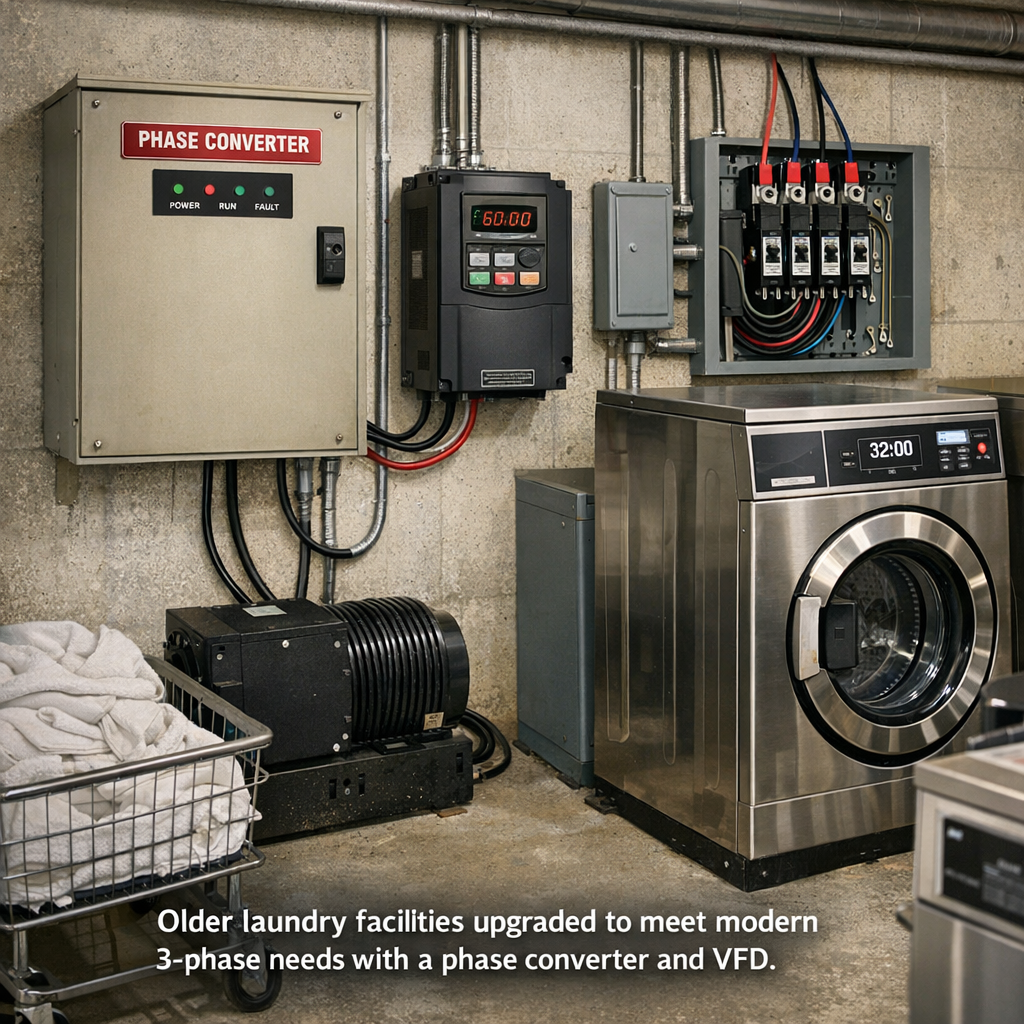
Owners of laundromats with older single-phase wiring systems face a unique challenge when trying to install modern 3-phase washers. The solution lies in understanding the differences between phase converters and variable frequency drives (VFDs) – two technologies designed to help convert or regulate power for optimal performance.
- Phase Converters: A Cost-Effective Solution
- VFDs: A More Efficient Approach
- The Bottom Line: Choosing the Right Path for Your Laundromat
Understanding Three-Phase Power and Its Benefits
Understanding Three-Phase Power and Its Benefits
Three-phase power is a common method of generating and distributing electricity worldwide, particularly in commercial and industrial settings. It consists of three individual sine waves that are evenly spaced in time, resulting in a more stable and predictable output than single-phase systems.
- One significant advantage of three-phase power is its ability to maintain consistent voltage levels. Since the load is balanced between the three phases, there is less overall variance compared to single-phase systems, which can experience voltage drops when large loads are applied.
- Another benefit is improved system efficiency and reduced energy consumption. By using a three-phase motor, less copper or aluminum wire is required in the motor windings, reducing resistance and power losses in the form of heat.
- Three-phase systems also offer increased reliability due to their ability to continue operating even if one phase experiences a fault. This redundancy helps prevent unexpected downtime and ensures that your laundromat remains open and serving customers.
The Challenges of Single-Phase Utility Hookups for Modern Laundromats
The Challenges of Single-Phase Utility Hookups for Modern Laundromats
Many older laundromat buildings are equipped with single-phase utility hookups, which can present challenges when trying to run modern 3-phase washers. This is because the 3-phase motor in these washers requires a balanced three-phase power source to operate efficiently and effectively.
- Firstly, running a 3-phase washer on a single-phase supply can result in inefficient energy usage due to the mismatched power supply. The 3-phase motor may overheat or suffer damage from the uneven load distribution caused by the single-phase input.
- Secondly, the lack of a balanced three-phase power source can lead to reduced performance and potentially even damaging the washer itself. This is because the unequal distribution of power can cause excessive stress on certain components within the motor, shortening its lifespan and possibly leading to costly repairs or replacements.
- Lastly, owners of laundromats may face increased energy costs when using a single-phase hookup for their 3-phase washer. This is because the mismatched power supply can result in more energy being used to compensate for the inefficiencies introduced by the single-phase input.
In order to overcome these challenges and effectively run modern 3-phase washers on single-phase utility hookups, laundromat owners should consider investing in either phase converters or Variable Frequency Drives (VFDs). Both of these solutions can help provide a balanced three-phase power source for the washer, ensuring efficient operation and longevity of the appliance.
Phase Converters: A Cost-effective Solution for Older Laundromat Buildings
Phase Converters: A Cost-Effective Solution for Older Laundromat Buildings
Phase converters are a popular choice among laundromat owners looking to modernize their facilities with advanced three-phase washing machines, despite having single-phase utility hookups. This cost-effective solution offers several benefits compared to using Variable Frequency Drives (VFDs), making it an attractive option for those on a budget.
- Adaptable Power Supply: Phase converters can seamlessly convert single-phase power into three-phase power, ensuring that modern washing machines operate at peak efficiency. VFDs may cause issues with the motor’s performance and lifespan due to their reliance on controlling voltage and frequency.
- Simpler Installation and Maintenance: Phase converters are typically smaller and simpler to install than VFDs, reducing installation time and cost. Additionally, they require less maintenance and monitoring compared to VFDs, which need regular calibration and have a higher likelihood of malfunctioning.
- Energy Efficiency: Phase converters can help reduce energy consumption by providing a more stable power supply for washing machines, leading to improved efficiency and potentially lower utility costs over time. In contrast, VFDs may cause fluctuations in voltage and frequency that could decrease overall energy efficiency.
In conclusion, phase converters offer a practical solution for laundromat owners seeking to upgrade their facilities without breaking the bank. By providing reliable three-phase power, simplifying installation and maintenance processes, and promoting energy efficiency, phase converters are an ideal choice for those looking to solve single-phase power issues in older laundromat buildings.
Variable Frequency Drives (VFDs): An Alternative to Phase Converters?
Variable Frequency Drives (VFDs): An Alternative to Phase Converters?
When it comes to solving three-phase power issues in older laundromat buildings, owners often face the challenge of running modern 3-phase washers on single-phase utility hookups. Two common solutions are variable frequency drives (VFDs) and phase converters. While phase converters have long been a go-to solution for this problem, VFDs are increasingly being considered as an alternative.
- VFDs provide a more cost-effective solution compared to traditional phase converters, especially when considering the initial investment required for installation.
- VFDs offer better control over motor speed and torque, allowing for improved efficiency and energy savings. This is particularly beneficial in laundromats where high-speed washing cycles can save time and money on electricity bills.
- Unlike phase converters, VFDs do not require a separate transformer for each load. This reduces the need for additional equipment and installation time, making it easier to retrofit existing systems.
Conclusion
Phase Converters vs. VFDs: Solving Three-Phase Power Issues in Older Laundromat Buildings
In this article, we have explored the technical differences between phase converters and variable frequency drives (VFDs) as potential solutions for owners needing to run modern 3-phase washers on single-phase utility hookups. Both options come with their advantages and disadvantages, but ultimately, it is up to the owner to decide which solution best suits their needs and budget.
- We compared the working principles of phase converters and VFDs, highlighting the importance of understanding these differences when selecting a power solution.
- We analyzed the benefits and drawbacks of each option in terms of efficiency, cost-effectiveness, and ease of installation and maintenance.
When faced with the challenge of retrofitting older laundromat buildings for modern 3-phase washers, it is crucial to consider both phase converters and VFDs as potential solutions. While VFDs may offer a more cost-effective solution in some cases, phase converters can provide a reliable and efficient alternative. It is essential for owners to conduct thorough research, consult with professionals, and make an informed decision based on their specific needs.
- Consult with a qualified electrician or industrial automation specialist to determine the most suitable solution for your laundromat.
- Compare the long-term costs and benefits of both options before making a final decision.
In conclusion, phase converters and VFDs provide viable solutions for owners needing to run modern 3-phase washers on single-phase utility hookups in older laundromat buildings. By understanding their technical differences, analyzing the pros and cons of each option, and consulting with professionals, owners can make an informed decision that best suits their needs and budget.
Leave a Reply