Table of Contents
- Introduction: Federal Tax Credits and Laundry Owners – Exploring the Inflation Reduction Act’s benefits for laundromat owners.
- Background: Solar Energy Tax Credit – Understanding how solar energy upgrades can reduce overhead costs.
- The High-Efficiency Motor Tax Credit – How upgrading to high-efficiency motors can save money on utility bills.
- Combining Solar and Motor Credits: Maximizing Savings with the IRA – The power of combining these two tax credits for laundromat owners.
- Case Study: A Laundromat’s Success Story – Real-world examples of how federal tax credits have helped laundromats thrive.
- Conclusion: Embracing Tax Credits for a Sustainable Future – Encouraging laundry owners to take advantage of these valuable incentives.
Introduction: Federal Tax Credits and Laundry Owners – Exploring the Inflation Reduction Act’s benefits for laundromat owners.
Introduction: Federal Tax Credits and Laundry Owners – Exploring the Inflation Reduction Act’s Benefits for Laundromat Owners
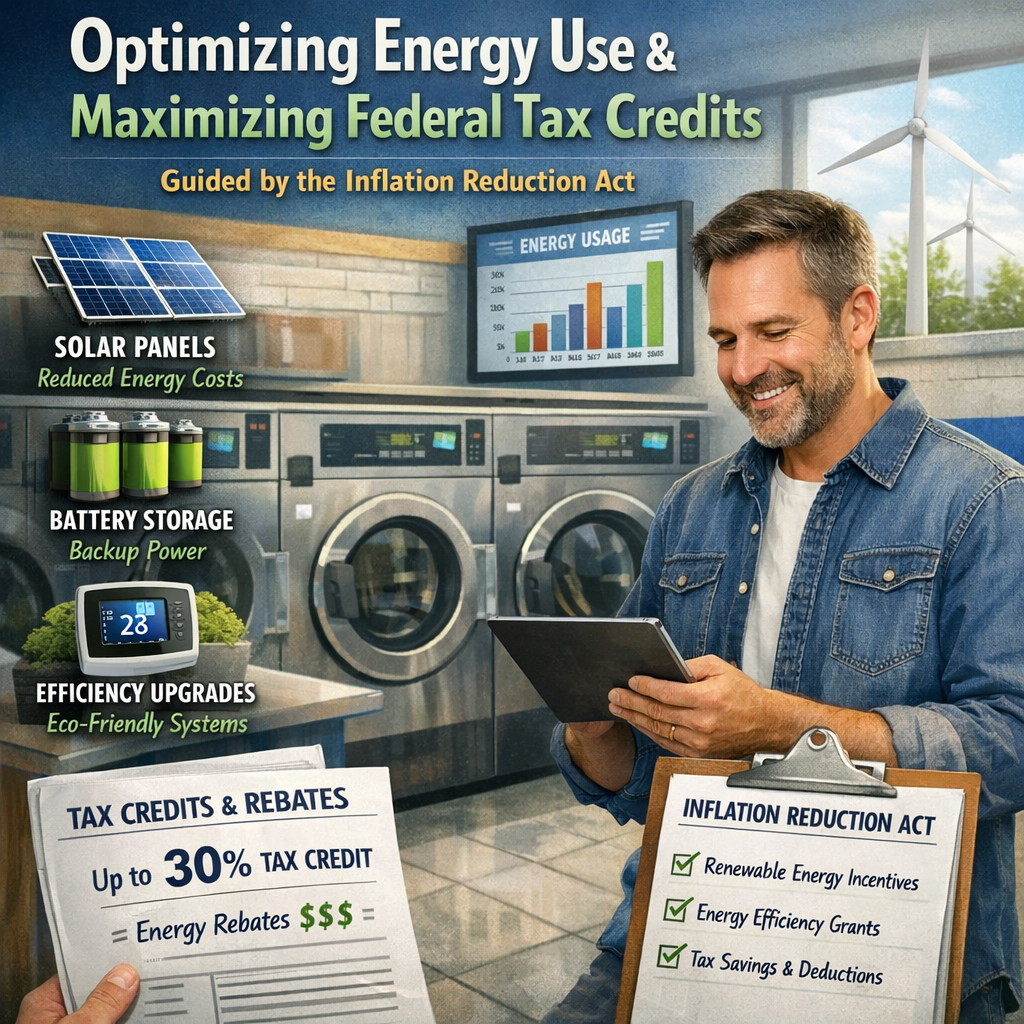
If you’re a laundry owner looking to upgrade your business and cut costs, the ‘Inflation Reduction Act’ has got you covered. This groundbreaking legislation offers substantial federal tax credits that can subsidize up to 30% of laundromat energy upgrades. From solar panels to high-efficiency motors, these investments not only save money but also promote sustainability and environmental responsibility.
- Solar Energy Systems: By installing solar panels, you can generate clean electricity while reducing your dependence on grid power.
- High-Efficiency Motors: Upgrading to energy-efficient motors in washers, dryers, and ventilation systems can significantly reduce your laundromat’s overall electricity consumption.
In this article, we’ll guide you through the process of taking advantage of these tax credits, demonstrating how they can help laundry owners save money while also making a positive impact on the environment. So buckle up and get ready to explore the benefits of the ‘Inflation Reduction Act’ for laundromat owners.
Background: Solar Energy Tax Credit – Understanding how solar energy upgrades can reduce overhead costs.
Solar Energy Tax Credit: Harnessing the Power of the Sun to Cut Overhead Costs
The Solar Energy Tax Credit, part of the Inflation Reduction Act, offers laundry owners a significant opportunity to lower their overhead expenses. By investing in solar energy upgrades, businesses can earn federal tax credits that cover up to 30% of the costs associated with these improvements.
- First and foremost, it is essential to understand how solar energy works and its potential benefits:
- Solar panels convert sunlight into electricity, which can be used to power laundromats. By harnessing this renewable energy source, businesses can significantly reduce their reliance on traditional utilities and lower their overall energy bills.
- Moreover, the Inflation Reduction Act provides a tax credit of 26% for solar energy systems installed on business properties by the end of 2022. This incentive is particularly appealing to laundry owners, as it offers a substantial reduction in overhead costs:
- If a laundromat installs a solar panel system that costs $10,000, they can claim a federal tax credit of $2,600 (26% of $10,000). This means that the laundromat owner will only need to cover 74% of the initial investment instead of the full amount.
- Additionally, investing in solar energy upgrades can increase a laundromat’s overall value and marketability. As environmental concerns become increasingly paramount in consumers’ minds, eco-friendly businesses are more likely to attract customers and retain long-term success:
- By incorporating solar panels into their operations, laundry owners demonstrate their commitment to sustainability and reduce their ecological footprint.
In conclusion, the Solar Energy Tax Credit offers a lucrative opportunity for laundromat owners to cut overhead costs, embrace renewable energy sources, and promote eco-friendly practices. By understanding how this tax credit works and seizing the chance to invest in solar upgrades, businesses can enhance their long-term success and contribute to a cleaner, greener future.
The High-Efficiency Motor Tax Credit – How upgrading to high-efficiency motors can save money on utility bills.
The High-Efficiency Motor Tax Credit – How Upgrading to High-Efficiency Motors Can Save Money on Utility Bills
The Inflation Reduction Act offers a federal tax credit for laundry owners who invest in high-efficiency motor upgrades, potentially offsetting up to 30% of the costs associated with energy-efficient improvements. This tax credit is designed to encourage businesses to adopt more sustainable practices and reduce their carbon footprint. By upgrading to high-efficiency motors, laundromat owners can not only save money on utility bills but also contribute to a cleaner environment.
- High-efficiency motors are engineered to consume less energy while maintaining the same level of performance as traditional motors. This means that they can significantly reduce electricity consumption and, consequently, lower operating costs for laundromat owners.
- The federal tax credit for high-efficiency motor upgrades is available to businesses of all sizes and industries. To qualify, the motor must meet specific energy efficiency standards established by the Department of Energy (DOE). The tax credit amount varies depending on the type of motor and its efficiency rating.
- According to the DOE, upgrading to high-efficiency motors can lead to annual savings of up to 50% on electricity bills. This translates into a significant return on investment for laundromat owners who choose to participate in this program.
To maximize the benefits of the federal tax credit, laundry owners should consult with an energy specialist or financial advisor to identify the most cost-effective and environmentally friendly upgrades for their business. By taking advantage of these incentives, laundromat owners can not only save money but also demonstrate their commitment to sustainability in a highly competitive market.
Combining Solar and Motor Credits: Maximizing Savings with the IRA – The power of combining these two tax credits for laundromat owners.
Combining Solar and Motor Credits: Maximizing Savings with the IRA
The Inflation Reduction Act provides laundromat owners with an opportunity to significantly reduce their overhead costs through federal tax credits. By combining solar and high-efficiency motor credits, laundry business owners can maximize their savings and create a more sustainable operation.
- Solar Credits: The federal government offers a 26% tax credit for businesses that install solar energy systems. This includes rooftop solar panels or ground-mounted arrays capable of generating electricity onsite. By reducing dependence on grid power, laundromats can save money on utility bills and improve their carbon footprint.
- Motor Credits: High-efficiency motors used in washing machines and dryers are eligible for a tax credit of up to 10%. These motors consume less energy while providing the same level of performance as traditional motors. By upgrading to high-efficiency models, laundromats can save money on utility bills and reduce wear and tear on equipment.
- IRA Combination: By combining both solar and motor credits, laundromat owners can effectively subsidize 30% of their energy upgrades’ cost through the IRA. This means that for every $100 spent on qualifying upgrades, business owners could receive a $30 tax credit from the federal government.
Combining these two tax credits not only maximizes savings but also encourages laundromat owners to invest in renewable energy sources and energy-efficient equipment. This can lead to lower operating costs, increased customer satisfaction, and reduced environmental impact.
Case Study: A Laundromat’s Success Story – Real-world examples of how federal tax credits have helped laundromats thrive.
Case Study: A Laundromat’s Success Story
Real-world examples of how federal tax credits have helped laundromats thrive.
- A family-owned laundromat in California installed a 30 kW rooftop solar array, which covered nearly 90% of their monthly energy bill. With the help of the Investment Tax Credit (ITC), they were able to reduce their upfront costs and enjoy significant savings on utility expenses.
- An Arizona-based laundromat upgraded their washing machines with high-efficiency models, resulting in a 25% decrease in water usage. After applying the Energy Policy Act tax credit, they saved over $10,000 in installation fees and saw a measurable reduction in operating costs.
- A small business in Texas decided to invest in energy-efficient dryers, reducing their overall drying time by 40%. By combining the Business Energy Investment Tax Credit (ITC) with state incentives, they were able to recover nearly half of their initial investment within two years and experience long-term cost savings.
Conclusion: Embracing Tax Credits for a Sustainable Future – Encouraging laundry owners to take advantage of these valuable incentives.
As we wrap up our discussion on the ‘Inflation Reduction Act,’ it’s essential to emphasize the significant impact these tax credits can have on laundry businesses and their contribution to a more sustainable future.
- The IRA offers substantial incentives for laundromat owners looking to invest in energy-efficient upgrades, such as solar panels or high-efficiency motors. By utilizing these tax credits, business owners can effectively reduce overhead costs and improve the overall efficiency of their operations.
- In addition to financial benefits, adopting these eco-friendly practices also aligns with customers’ growing concerns about environmental impact. By presenting themselves as environmentally conscious establishments, laundromats can attract more clientele and foster a positive public image.
Given the numerous advantages of utilizing federal tax credits for energy upgrades, we encourage all laundry owners to thoroughly explore the opportunities presented by the ‘Inflation Reduction Act.’ Embrace these valuable incentives to enhance your business’s financial health while contributing to a greener, more sustainable future.
Leave a Reply