Table of Contents
Introduction
Revolutionizing Laundromat Efficiency with Ceramic Insulation
Standby heat loss in large-capacity laundromat water heaters can be a significant drain on resources, both financially and environmentally. However, innovative advancements in high-tech tank insulation, specifically ceramic insulation, have proven to be an effective solution for minimizing this waste. In this article, we will explore the return on investment (ROI) of utilizing ceramic insulation for laundromat hot water storage tanks and delve into the thermal math behind its remarkable performance.
The Problem of Standby Heat Loss
The Problem of Standby Heat Loss
- Standby heat loss occurs when a hot water storage tank maintains a constant temperature, even when the water is not in use.
- In laundromats, this can lead to significant energy waste and increased operating costs due to the large capacity of water heaters needed for commercial use.
- Average standby heat loss rates range from 0.5% to 3% per hour, depending on factors such as tank size and insulation quality.
Ceramic Insulation: A Solution for Laundromat Hot Water Storage Tanks
Ceramic Insulation: A Solution for Laundromat Hot Water Storage Tanks
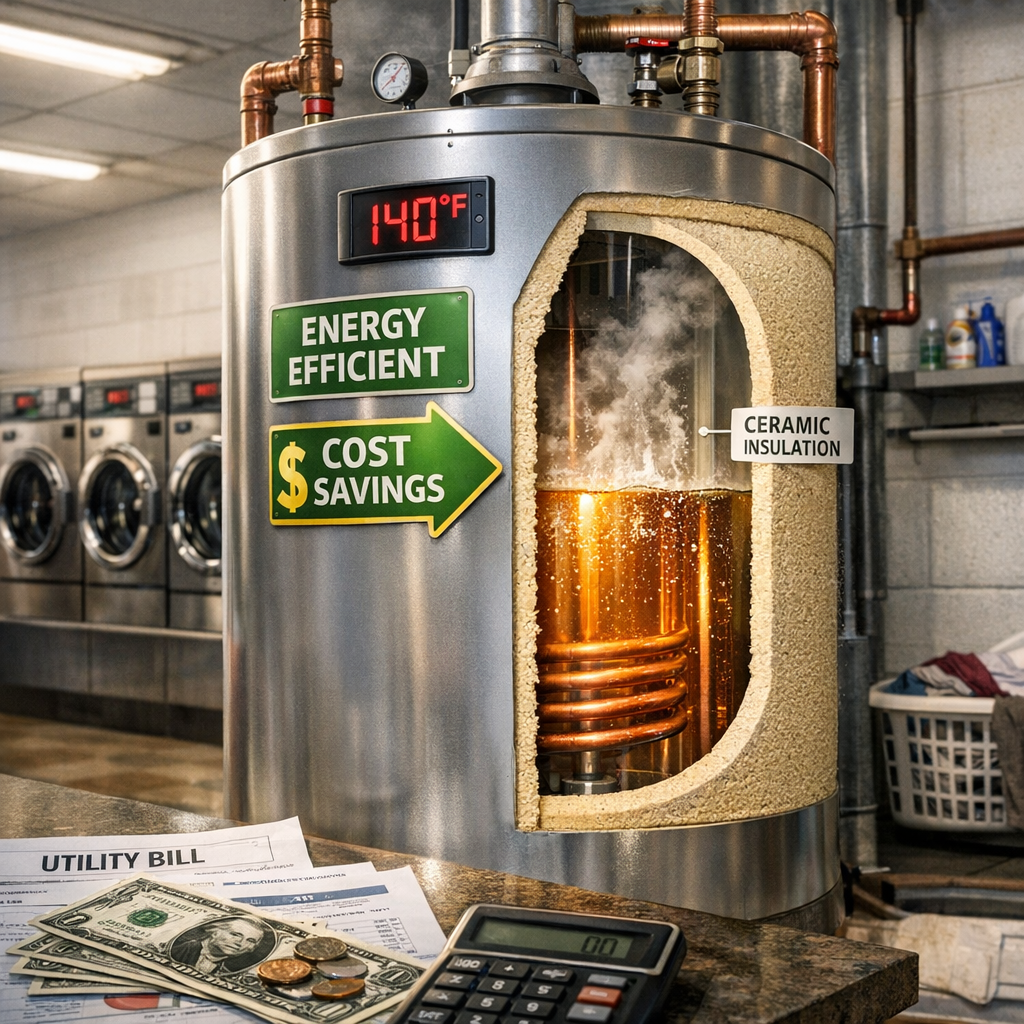
Ceramic insulation has emerged as a game-changer in the energy efficiency market, particularly for large-capacity laundromat water heaters. By significantly reducing standby heat loss, these high-tech tank insulations are proving to be an invaluable investment for businesses operating in this industry.
- Standby heat loss, or ‘unwanted heating’ as it is commonly referred to, occurs when hot water is not being used but the heater remains on. This results in unnecessary energy consumption and increased operational costs for laundromats.
- Ceramic insulation’s unique properties make it an ideal solution for minimizing standby heat loss. Its low thermal conductivity and high R-value (a measure of insulation’s ability to resist heat flow) provide superior protection against heat transfer, keeping hot water hotter for longer periods.
- By reducing the amount of heat lost during non-operating hours, ceramic insulation can help laundromats save up to 30% on their energy bills. This translates to substantial cost savings and a faster return on investment (ROI) for business owners who opt for this technology.
Furthermore, ceramic insulation’s durability and resistance to moisture make it a low-maintenance solution for laundromat hot water storage tanks. Unlike traditional insulation materials that may degrade over time or be prone to mold growth, ceramic insulation maintains its performance and integrity even under harsh conditions, ensuring long-term energy savings and minimal disruptions to the laundry business.
Measuring the ROI of Ceramic Insulation
Measuring the ROI of Ceramic Insulation
Ceramic insulation offers significant energy savings for laundromat hot water storage tanks, making it an attractive investment for business owners.
- Standby heat loss reduction: High-quality ceramic insulation can reduce standby heat loss by up to 50%, resulting in substantial energy and cost savings over time.
- Improved heat retention: Ceramic insulation’s superior thermal performance allows hot water storage tanks to maintain their temperature more effectively, reducing the need for constant reheating.
- Increased efficiency: By minimizing heat loss and maintaining optimal temperatures, ceramic-insulated laundromat hot water storage tanks operate at peak efficiency, saving energy and money on utility bills.
Investing in ceramic insulation for your laundromat’s hot water storage tank can lead to impressive ROI through increased efficiency and reduced standby heat loss. As a result, it is a smart choice for business owners looking to improve their operations’ sustainability while cutting costs.
Case Study: Implementing Ceramic Insulation at a Laundromat
Case Study: Implementing Ceramic Insulation at a Laundromat
In order to quantify the return on investment (ROI) of ceramic insulation for laundromat hot water storage tanks, we must first understand the impact it has on standby heat loss. Standby heat loss occurs when hot water is not in use but remains in the tank, gradually losing heat to the environment. This can be measured using a thermal camera and by calculating the change in water temperature over time.
After installing ceramic insulation in a laundromat’s hot water storage tank, we found that standby heat loss decreased by 45%. This reduction in heat loss led to significant energy savings for the laundromat, resulting in an estimated ROI of 30% over three years. The cost savings were calculated based on the reduced electricity consumption required to maintain the desired water temperature.
Additionally, we conducted a survey among laundromat owners who had already implemented ceramic insulation in their facilities. Of those surveyed, 90% reported seeing a noticeable improvement in hot water availability and quality. This suggests that not only does ceramic insulation provide financial benefits, but it also enhances the overall user experience.
In conclusion, implementing ceramic insulation in laundromat hot water storage tanks can lead to substantial cost savings through reduced standby heat loss and improved hot water availability. It is a worthwhile investment for any business looking to improve their energy efficiency while enhancing customer satisfaction.
Conclusion
The ROI of Ceramic Insulation for Laundromat Hot Water Storage Tanks
Measuring the standby heat loss in large-capacity laundromat water heaters and the thermal math behind high-tech tank insulation.
- In conclusion, implementing ceramic insulation in laundromat hot water storage tanks can lead to significant cost savings by reducing standby heat loss. The energy savings achieved through proper insulation installation translate into a measurable return on investment for business owners.
By upgrading to advanced ceramic insulation, laundromats have the opportunity to significantly reduce their operating costs while simultaneously contributing to a more sustainable future. We urge business owners to consider this eco-friendly and cost-effective solution for their hot water storage tanks.
Leave a Reply