Table of Contents
Introduction
Static Backpressure Analysis: Measuring Duct Resistance in Commercial Laundromat Exhaust Systems
In the world of commercial laundromats, efficient operation is crucial for maintaining profitability and providing quality service to customers. One often-overlooked aspect of a laundromat’s performance is its exhaust system, particularly the ductwork that connects the dryers to the exterior venting. In this deep dive into engineering, we will explore how poorly designed ductwork can lead to increased dryer cycle times and reduced gas efficiency.
When a laundromat owner opens their doors each day, they rely on their equipment to work efficiently and effectively. However, many commercial laundry systems suffer from one common issue: inefficient exhaust systems. This problem is often rooted in the ductwork connecting the dryers to the exterior venting. In this article, we will delve into the world of static backpressure analysis and explore how measuring duct resistance can help improve a laundromat’s overall performance.
Understanding Static Backpressure
Understanding Static Backpressure
In commercial laundromats, exhaust systems play a crucial role in maintaining energy efficiency and optimal dryer performance. One key factor affecting these systems is static backpressure, which can significantly increase dryer cycle times and diminish gas efficiency if not properly understood and mitigated.
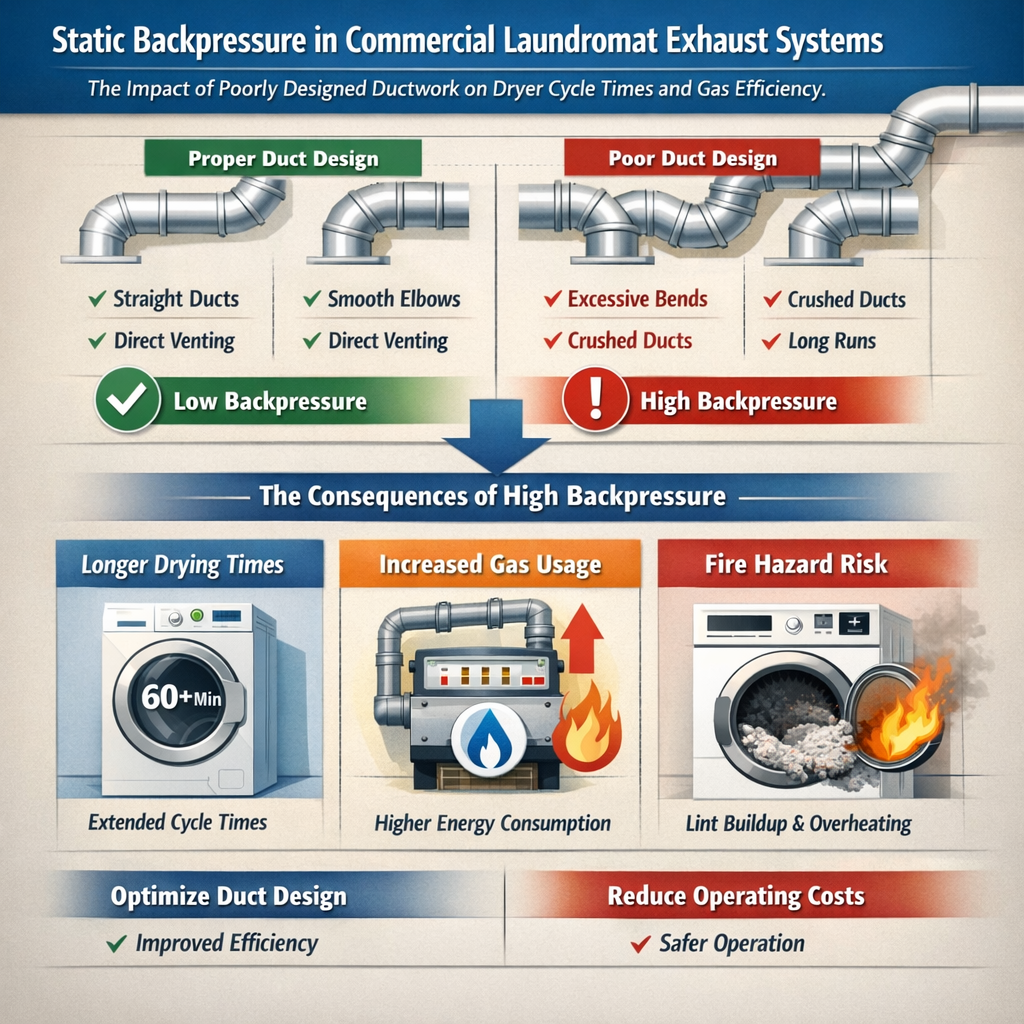
- Static backpressure is the pressure exerted by the airflow resistance within a system. In laundromat exhaust systems, this occurs when the airflow is obstructed by poorly designed or inadequately sized ductwork.
- The buildup of static backpressure forces air to move more slowly through the ducts, resulting in increased dryer cycle times and reduced efficiency of gas combustion.
- Consequences of high backpressure include decreased overall laundromat productivity, higher energy costs, and potential damage to the dryer’s engine due to prolonged exposure to elevated temperatures.
To combat static backpressure in commercial laundromats, it is essential to implement proper duct design and sizing. This includes ensuring that ducts are wide enough to accommodate the required airflow without causing unnecessary resistance, as well as maintaining smooth surfaces to minimize turbulence and obstruction within the ductwork.
Identifying Symptoms of Poor Duct Resistance
Identifying Symptoms of Poor Duct Resistance
In commercial laundromats, the exhaust system plays a crucial role in maintaining gas efficiency and reducing dryer cycle times. However, poorly designed ductwork can lead to several issues that impact overall performance. Here are some common symptoms of poor duct resistance:
- Increased dryer cycle times: If your dryers are taking longer than usual to complete a cycle, it could be an indication of insufficient duct resistance.
- Ventilation issues: Poorly designed ductwork can cause uneven air distribution or insufficient airflow, leading to uncomfortable environments for employees and customers alike.
- Energy waste: Inefficient duct systems can result in significant energy loss through poor ventilation, which not only increases operating costs but also harms the environment.
- Noise pollution: Imbalances in air pressure caused by inadequate duct resistance can lead to unwanted noise from fans and other equipment, disrupting the peace of your local laundromat.
Measuring Duct Resistance in Commercial Laundromats
Measuring Duct Resistance in Commercial Laundromats
In order to accurately measure duct resistance, a comprehensive approach must be taken, considering factors such as airflow rates, temperature differences, and pressure losses across the system.
- Firstly, it is essential to determine the total duct area, which can be calculated by summing up the areas of individual duct segments. This information is crucial for understanding overall airflow patterns and identifying any bottlenecks or restrictions in the system.
- Next, measure the velocity of air flowing through each duct section using an anemometer. This data will help to estimate the volume flow rates, which can then be used to calculate pressure drops across different components within the system.
- To assess the impact of varying airflow rates on overall system performance, it is necessary to monitor temperature differences between supply and return air streams. This information can provide valuable insights into the efficiency of heat transfer processes and help identify areas where improvements may be needed.
- Finally, calculate the pressure loss due to duct resistance by analyzing the data obtained from previous steps. This can be done using various equations, such as the Darcy-Weisbach equation or the Fanning friction factor formula. By understanding the relationship between pressure loss and airflow rate, it becomes possible to optimize commercial laundromat exhaust systems for maximum efficiency.
Mitigating the Impact of Poor Duct Resistance
Mitigating the Impact of Poor Duct Resistance
Static backpressure analysis is a crucial tool for identifying and addressing issues related to duct resistance in commercial laundromat exhaust systems. By understanding the root causes of these problems, engineers can develop more effective solutions to mitigate their impact on dryer cycle times and gas efficiency.
- One major contributor to poor duct resistance is improperly sized or installed exhaust ducts. These issues can lead to increased backpressure, which in turn increases the time it takes for laundry to dry and reduces overall gas efficiency.
- Another common problem is the presence of sharp bends or restrictive elements within the ductwork. These factors can cause significant pressure drops, leading to reduced airflow and inefficient operation.
To address these issues, engineers must first conduct a thorough static backpressure analysis to identify the root causes of poor duct resistance. This may involve using computational fluid dynamics (CFD) simulations or other analytical tools to model the behavior of exhaust gases within the laundromat’s ductwork system.
Once the causes of poor duct resistance have been identified, engineers can then implement targeted solutions to mitigate their impact on dryer cycle times and gas efficiency. This may include:
- Sizing and adjusting exhaust ducts to ensure proper airflow and minimize backpressure
- Eliminating sharp bends or other restrictive elements within the ductwork system
In conclusion, by utilizing static backpressure analysis and implementing targeted solutions based on its findings, engineers can significantly improve the performance of commercial laundromat exhaust systems. This not only results in faster dryer cycle times but also helps to preserve valuable gas resources, ultimately benefiting both businesses and consumers alike.
Conclusion and Recommendations
In this article, we have delved into the world of static backpressure analysis and its applications in commercial laundromat exhaust systems. We have discussed how poorly designed ductwork can lead to increased dryer cycle times and decreased gas efficiency in a laundromat.
- Firstly, we explored the basics of duct resistance and its impact on performance.
- Next, we examined real-world case studies that demonstrate the importance of proper duct design.
- Finally, we provided practical recommendations for laundromat owners and engineers to improve their exhaust systems’ efficiency.
Conclusion:
Static backpressure analysis is a powerful tool in identifying and resolving performance issues caused by poorly designed ductwork in commercial laundromat exhaust systems. By understanding the importance of proper duct design, laundromat owners and engineers can improve their businesses’ efficiency and reduce their operating costs.
If you’re a laundromat owner or engineer facing performance issues, we strongly recommend conducting a static backpressure analysis to identify any potential ductwork problems. Addressing these issues promptly will not only help maintain your business’s productivity but also contribute to a cleaner environment by reducing unwanted emissions.
Remember, small improvements can lead to significant savings in the long run. So don’t neglect the importance of properly designed exhaust systems in your commercial laundromat.
Leave a Reply