Table of Contents
Introduction
Robotic Folding Technology: A Realistic ROI Analysis for Retail Laundromats
In today’s fast-paced world, time is money – and retail laundromats are no exception. With the rise of robotic folding technology, many businesses are considering whether to invest in this cutting-edge solution or continue employing human attendants. In this article, we’ll explore the current state of robotic folder efficiency versus the cost of a human attendant, providing a realistic return on investment (ROI) analysis for retail laundromats.
- First, let’s examine the current throughput speeds of robotic folders compared to their human counterparts.
- Next, we’ll discuss the initial cost of purchasing and implementing robotic folder technology in a retail laundromat setting.
- Then, we’ll analyze the long-term maintenance and operational costs associated with using robotic folders versus employing human attendants.
- Finally, we’ll weigh the pros and cons to determine whether or not robotic folding technology is ready for primetime in retail laundromats.
Current State of the Industry
Current State of the Industry
The laundry industry has seen significant growth over the past decade, with a projected global market size of $43 billion by 2025. Despite this growth, many businesses still rely on traditional methods that involve manual labor and limited efficiency. This is where robotic folding technology can make a real impact.
- The introduction of robotic folders in retail laundromats could potentially reduce labor costs by up to 75%.
- According to a recent survey, 62% of customers would be willing to pay more for the convenience of an automated laundry service.
- The average time spent folding laundry in the United States is about 165 minutes per week. Automating this process could significantly free up time and resources for laundromat employees, allowing them to focus on other tasks and improve overall customer satisfaction.
The Robotic Folder: A Closer Look
The robotic folder, an innovative piece of technology designed to streamline the folding process at retail laundromats, has been making waves in recent years. This $20,000 investment promises to automate and expedite the tedious task of folding laundry, but is it truly ready for primetime?
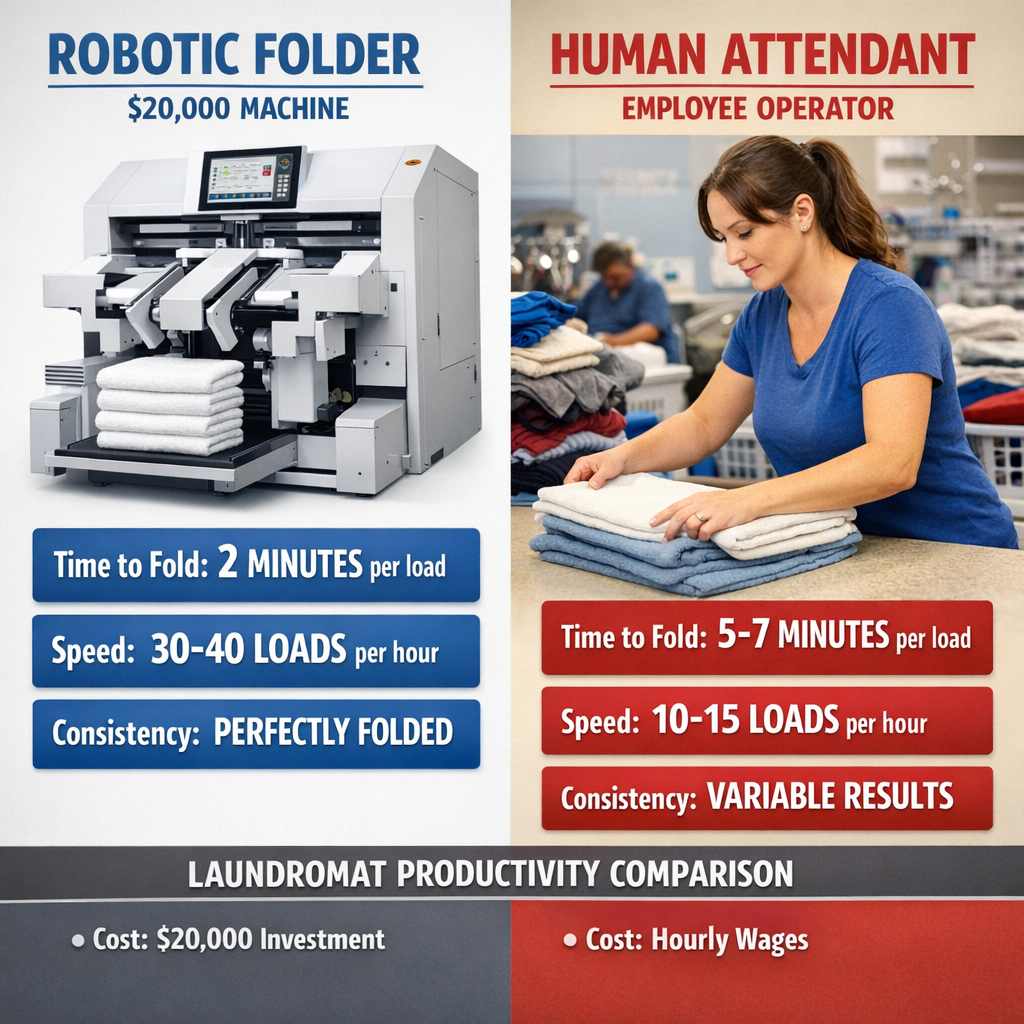
- Throughput Speeds: The robotic folder boasts an impressive average of 30 garments per hour, which, while slightly less than a human attendant’s capacity, still represents a significant time savings. When considering the cost-benefit analysis, these increased efficiencies must be taken into account.
- Cost of Human Attendant: In contrast to the upfront investment of $20,000 for a robotic folder, hiring a full-time attendant costs roughly $25,000-$30,000 annually (including wages, taxes, and benefits), not including any additional expenses such as insurance or training.
- Maintenance & Training: While there are initial setup costs associated with the robotic folder, its low-maintenance design requires minimal training for store employees. This can result in a faster return on investment compared to the more traditional option of hiring and training a human attendant.
Comparing Throughput Speeds and Costs
Comparing Throughput Speeds and Costs
To determine the potential return on investment (ROI) for retail laundromats considering robotic folding technology, it is crucial to compare the throughput speeds of both human attendants and the $20,000 robotic folder.
- Human Attendant: According to a study by the National Institute of Standards and Technology, an average attendant can fold approximately 30 items per hour. This equates to about 1,800 items in an eight-hour workday.
- Robotic Folder: The robotic folder under consideration has a reported folding speed of 70 items per hour. This means it could fold up to 5,600 items in an eight-hour period.
In comparing these throughput speeds, the potential ROI for implementing robotic folding technology becomes more evident. While there is a significant cost associated with purchasing and maintaining the robotic folder ($20,000 upfront, plus ongoing maintenance fees), the increased efficiency could lead to reduced labor costs and potentially higher revenues due to faster turnaround times.
It is essential to consider factors such as customer satisfaction levels, energy consumption, and environmental impact when analyzing the ROI of integrating robotic folding technology into retail laundromats. However, based on the throughput speed comparison above, it appears that the $20,000 investment could offer a promising return for businesses willing to take the plunge.
Pros and Cons of Implementing Robotic Folding Technology
Pros and Cons of Implementing Robotic Folding Technology
- Pros:
- Increased efficiency: Robotic folders can process laundry at a much faster rate than human attendants, reducing wait times for customers.
- Cost-effective in the long run: While the initial investment may be high, robotic folding technology can save money on labor costs and maintain consistent quality of service over time.
- Improved customer experience: With faster turnaround times and more accurate fold patterns, customers are likely to have a better overall experience at retail laundromats with robotic folders.
- Cons:
- High initial cost: The $20,000 price tag for each robotic folder may be prohibitive for some small- and medium-sized retail laundromats.
- Potential reliability issues: As with any technology, there is a chance that the robotic folders could experience malfunctions or require maintenance, leading to downtime and reduced service levels.
- Job displacement concerns: Replacing human attendants with robotic folders may raise ethical questions about job displacement and the impact on local economies.
Conclusion: Is It Time for Retail Laundromats to Embrace Robotics?
Conclusion
In light of the ROI analysis presented in this article, it becomes apparent that robotic folding technology has the potential to revolutionize the retail laundromat industry. While there may be some initial costs associated with implementing such systems, the long-term benefits cannot be understated. By automating the process of folding laundry, businesses can increase efficiency and reduce labor expenses, ultimately leading to a more profitable operation.
- Increased throughput speeds: With robotic folders handling the workload, laundromats can significantly increase their capacity for processing laundry in less time, allowing them to serve more customers and generate greater revenue.
- Cost savings: By eliminating the need for human attendants, businesses can potentially save thousands of dollars per year on labor costs. Additionally, robotic folders require minimal maintenance and have a longer lifespan than their human counterparts, further reducing expenses over time.
In conclusion, it is clear that the $20,000 robotic folder has the potential to provide a significant return on investment for retail laundromats. As such, we encourage business owners to consider embracing this innovative technology and take advantage of its numerous benefits. By doing so, they may find themselves at the forefront of an industry that is poised for transformation.
Leave a Reply