Table of Contents
Introduction to Optical Brighteners
Optical Brighteners: Unraveling the Mystery Behind Your Yellow Laundromat Linens
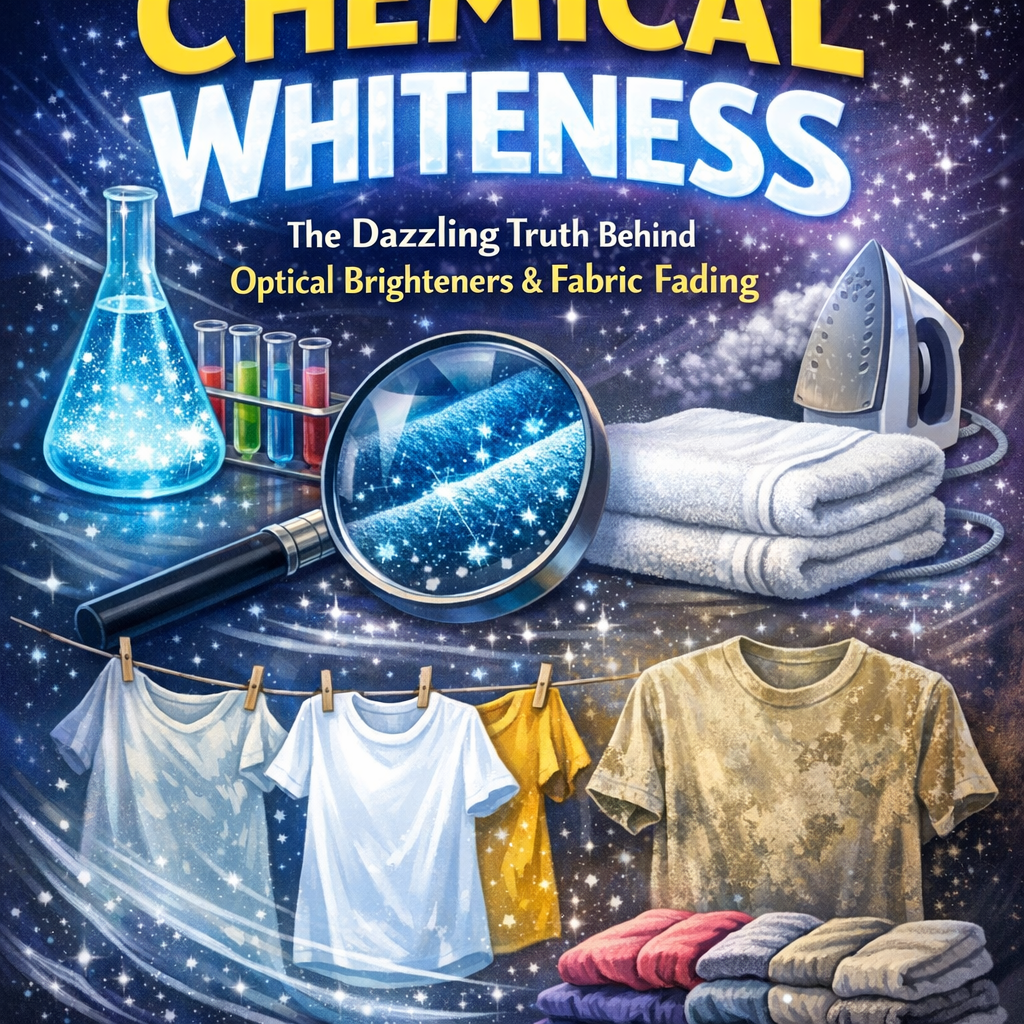
Have you ever noticed that your freshly washed linens appear unnaturally bright and clean at first, only to gradually turn yellow over time? This curious phenomenon is the result of a fascinating chemical process involving optical brighteners – also known as fluorescent whitening agents. In this article, we will explore how these substances work and their impact on fabric discoloration.
- First, let’s delve into what optical brighteners actually are:
The Chemistry of Fluorescent Whitening Agents
Fluorescent whitening agents, or optical brighteners, are synthetic compounds that make colors appear brighter and whiter by fluorescing under ultraviolet light. These chemicals work by absorbing ultraviolet (UV) radiation and then emitting visible light, which is perceived as a brighter shade of the color.
- Optical brighteners consist of two main types: stilbene-based and benzophenone-based compounds. Stilbenes are organic compounds with a structure containing two aromatic rings connected by a single bond, while benzophenones have an aromatic ring fused to a phenolic hydroxyl group.
- The most common optical brightener is benzoxazole, which is used in a wide range of applications, including textiles, paper, and detergents. It is particularly effective at brightening pastel colors and white.
- Optical brighteners are added to fabrics during the dyeing process or applied through laundry detergent formulations. Once bound to the fabric, these molecules remain trapped within the fibers, causing the persistent yellowing effect known as ‘laundromat linens.’
Although fluorescent whitening agents provide many benefits for color enhancement and maintenance, they can cause discoloration when exposed to high levels of UV radiation. This occurs because the intense emission of visible light over time causes a chemical reaction within the fabric, leading to irreversible yellowing. The technical ‘point of no return’ is reached when the concentration of optical brighteners in the fabric reaches a certain threshold, causing permanent color changes.
How Optical Brighteners Work in Laundry
Optical brighteners, also known as fluorescent whitening agents (FWAs), are chemicals that enhance the appearance of white or light-colored fabrics by reflecting ultraviolet (UV) light. They work by absorbing UV radiation and re-emitting it at a longer wavelength, which appears as visible blue light to our eyes.
To understand how optical brighteners work in laundry, we must first examine their molecular structure. These molecules have two key components: a chromophore group that absorbs UV light and a conjugated system of alternating single and double bonds, which allows the molecule to absorb higher energy (shorter wavelength) UV radiation efficiently.
When an FWA molecule encounters a fabric’s surface, it becomes oriented in such a way that its chromophore group is exposed to the surrounding environment. When UV light strikes the fabric, the FWA absorbs this radiation and undergoes a conformational change, causing the conjugated system to expand. This process promotes the excitation of electrons within the molecule.
As the excited electron returns to its ground state, energy is released in the form of visible blue light. Since the emitted light has a longer wavelength than the absorbed UV radiation, it appears as yellow or whitish hues when reflected off the fabric’s surface. This phenomenon creates the illusion of a brighter and cleaner-looking garment.
However, over time, continuous exposure to UV light and washing processes can cause the optical brightener molecules to break down or become less effective. When this occurs, the once-bright fabric begins to yellow, leading to discoloration and an overall decline in appearance.
The Point of No Return: When Yellowing Occurs
The Point of No Return: When Yellowing Occurs
Optical brighteners, or fluorescent whitening agents (FWAs), are chemicals added to laundry detergents to enhance the brightness and whiteness of fabrics. These substances work by absorbing ultraviolet (UV) light and re-emitting it at a longer wavelength, which appears as visible light. This process makes the fabric appear brighter and whiter under normal light conditions.
However, over time and with repeated washing, optical brighteners can cause fabrics to yellow or become discolored. This occurs when the intensity of the UV light absorbed by the FWA exceeds its capacity to re-emit it as visible light. At this point, known as the ‘point of no return,’ the FWA molecules begin to break down and form chromophores, which absorb visible light and contribute to fabric discoloration.
- Optical brighteners work by absorbing UV light and re-emitting it at a longer wavelength for enhanced brightness.
- The ‘point of no return’ is the threshold where optical brighteners cause fabric discoloration due to their breakdown and formation of chromophores.
Understanding Fabric Discoloration and its Causes
Understanding Fabric Discoloration and its Causes
Fabric discoloration, particularly the yellowing of laundromat linens over time, can be attributed to the presence of optical brighteners in washing processes.
- Optical brighteners, also known as fluorescent whitening agents (FWAs), are chemicals added to laundry detergents and other cleaning products.
- These substances absorb ultraviolet (UV) light and re-emit it as visible light, causing fabrics to appear brighter or whiter under normal lighting conditions.
- However, prolonged exposure to UV light can cause the optical brighteners to break down, leading to a yellowing effect on the fabric over time.
Conclusion: Balancing Brightness with Environmental Responsibility
Conclusion: Balancing Brightness with Environmental Responsibility
In light of the environmental concerns surrounding optical brighteners, it is crucial for consumers to be aware of their impact and take action to minimize their use. By opting for eco-friendly laundry products or using natural alternatives like lemon juice or baking soda, we can reduce our carbon footprint while maintaining the brightness of our laundromat linens.
- Choose eco-friendly laundry detergents that do not contain optical brighteners.
- Use natural alternatives such as lemon juice or baking soda to achieve a brighter appearance without harsh chemicals.
- Educate others about the environmental impact of optical brighteners and encourage them to adopt more sustainable practices in their own laundry routines.
By making conscious choices and spreading awareness, we can strike a balance between maintaining the brightness of our fabrics and preserving the health of our planet. After all, a little effort goes a long way in ensuring a cleaner, greener future for generations to come.
Leave a Reply