Table of Contents
Introduction
Gas Manifold Pressure Testing: A Step-by-Step Calibration for Laundromat Maintenance
Optimizing your laundromat’s performance is crucial to keep customers satisfied and ensure the longevity of your equipment. One critical aspect that often goes overlooked is maintaining the proper gas manifold pressure in your dryers. In this article, we will guide you through a step-by-step process of calibrating your gas manifold using a manometer to guarantee optimal garment drying without wasting fuel.
Keeping up with regular maintenance and calibration checks can save you money on fuel costs and prevent costly repairs down the line. Let’s dive into how you can easily perform gas manifold pressure testing for your laundromat dryers!
Understanding Gas Manifold Pressure Testing
Understanding Gas Manifold Pressure Testing
To effectively maintain your laundromat’s dryers, it is crucial to have a comprehensive understanding of gas manifold pressure testing. This process ensures that each dryer receives the precise amount of BTUs required for optimal garment drying without wasting fuel.
Before diving into the step-by-step calibration process, let us first discuss the importance of maintaining proper gas pressure in your laundromat’s dryers.
1. The Importance of Proper Gas Pressure
Proper gas pressure is essential for ensuring efficient and safe operation of your laundromat’s dryers. By maintaining the correct gas pressure, you can prevent damage to the dryers and extend their lifespan. Additionally, proper gas pressure helps maintain consistent drying times and results, leading to a higher level of customer satisfaction.
2. Tools Required for Gas Manifold Pressure Testing
To perform gas manifold pressure testing, you will need several tools and materials:
– A manometer
– A gas pressure regulator
– A set of test gauges or pressure gauges
– Pipe thread compound (optional)
– A cleaning cloth
– A pencil or marker to label your gauges
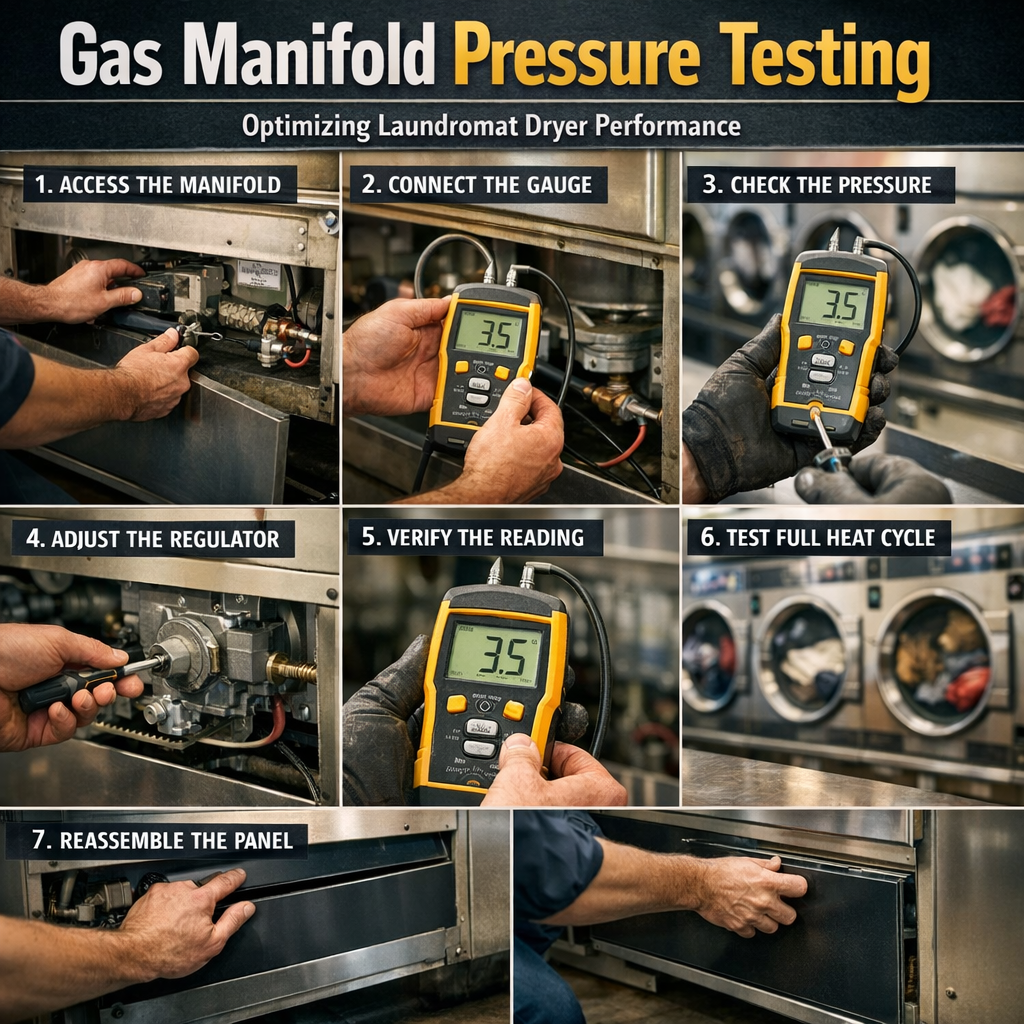
3. Step-by-Step Calibration Process
Once you have gathered the necessary tools and materials, follow these steps for calibrating your laundromat’s dryers:
a. Turn off the gas supply to the dryer.
b. Connect the manometer to the gas supply line using a high-quality fitting. Ensure that there are no leaks by applying soapy water around the connection point.
c. Attach one of the test gauges to the manifold valve, ensuring a tight seal. Close the valve.
d. Slowly open the valve while monitoring the pressure on the manometer. Record the pressure reading in psi (pounds per square inch) or kPa (kilopascals).
e. Repeat steps c and d for each remaining test gauge. If you have multiple dryers, repeat this process for each one.
f. After obtaining accurate pressure readings from all gauges, compare them to the manufacturer’s recommended pressure specifications for your specific dryer models. Adjust the gas pressure regulator as needed to achieve the correct pressure.
g. Once you have adjusted the pressure regulator(s), recheck the pressure readings on your test gauges. Ensure that they are within the manufacturer’s recommended range.
h. If necessary, repeat steps f and g until you achieve the desired pressure levels.
4. Regular Maintenance and Inspections
To ensure continued optimal performance of your laundromat’s dryers, it is essential to perform gas manifold pressure testing regularly. Schedule routine maintenance inspections with a qualified professional who can inspect your gas system for leaks, corrosion, or other issues that may impact pressure regulation.
By following these steps and implementing regular maintenance practices, you can ensure the efficient and safe operation of your laundromat’s dryers, ultimately benefiting both your business and your customers.
Gathering Necessary Tools and Equipment
Gathering Necessary Tools and Equipment
Before beginning the gas manifold pressure testing process, it is essential to have all necessary tools and equipment at hand. Here is a list of items you will need:
- A manometer or pressure gauge with appropriate range for your laundromat’s dryers.
- A gas pressure test kit, including hoses, gauges, and fittings.
- Calibration tools, such as a digital caliper or micrometer, to ensure accurate measurements.
- A vial or bottle for collecting gas samples, if required by your testing method.
Preparing Your Laundromat Dryers
Preparing Your Laundromat Dryers
To prepare your laundromat dryers for gas manifold pressure testing, follow these steps:
- Ensure all dryers are turned off and have cooled down.
- Close the fuel valve to each dryer’s gas supply line.
- Attach a manometer to one of the dryers’ gas supply lines. Make sure it is properly calibrated and functioning correctly.
- Slowly open the fuel valve for the first dryer, allowing gas to flow through the manifold and into the manometer. Record the pressure reading in psi (pounds per square inch).
- Repeat this process for each of your dryers, adjusting the fuel valves as needed to achieve the desired pressure.
Performing the Step-by-Step Calibration Process
Step-by-Step Calibration Process
- First, ensure your gas manifold pressure testing equipment is in good working condition and properly calibrated.
- Securely attach the manometer to the gas manifold system’s pressure gauge.
- Turn on the gas supply and adjust the main gas valve to allow a slow flow of gas through the system. Do not turn on any individual dryer valves yet.
- Measure the pressure difference between the incoming gas supply and the exhaust gas leaving the manifold by reading the manometer’s gauge. This is your baseline pressure.
- Turn off the gas supply and adjust each dryer valve to its designated BTU setting according to the manufacturer’s specifications.
- One at a time, turn on individual dryers and measure the pressure difference between the incoming gas supply and the exhaust gas leaving the manifold for each dryer. Record these measurements.
- Calculate the average pressure difference for all dryers by adding the recorded pressures and dividing by the total number of dryers. This is your target pressure.
- Adjust the main gas valve to achieve the desired target pressure, ensuring that all dryers receive the correct amount of gas.
- Periodically recheck your calibration process to maintain optimal gas flow and efficiency in your laundromat’s dryer systems.
Conclusion: Optimal Fuel Efficiency for Your Laundromat
Conclusion: Optimal Fuel Efficiency for Your Laundromat
In conclusion, proper gas manifold pressure testing is essential for maintaining optimal fuel efficiency in your laundromat. By following the step-by-step calibration process outlined in this article, you can ensure that your dryers are receiving the exact BTUs required for efficient garment drying without wasting fuel.
- Always use a manometer to accurately measure gas pressure and maintain consistent levels.
- Regularly inspect and service your gas manifold system to prevent leaks or other issues that could affect fuel efficiency.
- Stay up-to-date with industry best practices and equipment advancements to continue optimizing your laundromat’s performance.
By implementing these strategies, you can not only save money on fuel costs but also contribute to a cleaner environment by reducing waste. Remember, a well-maintained laundromat is not only good for business, it’s good for the planet!
Leave a Reply