Table of Contents
Introduction
ADA Path of Travel: Ensuring Your Laundromat Folding Tables Meet Federal Standards
In the ever-evolving landscape of accessibility laws, one must not overlook the significance of the Americans with Disabilities Act (ADA). This comprehensive legislation outlines federal standards that businesses and public entities must adhere to in order to ensure equal access for individuals with disabilities. Today, we delve into the intricacies of one such aspect: laundromat folding tables.
While many may view laundromats as a relic of the past, they continue to be an essential service provider for millions of people across the United States. As laundry facilities evolve and modernize their offerings, it is imperative that they do not forget the importance of adhering to ADA guidelines. Failure to do so can result in predatory disability lawsuits and severe financial repercussions.
- Understanding the federal standards
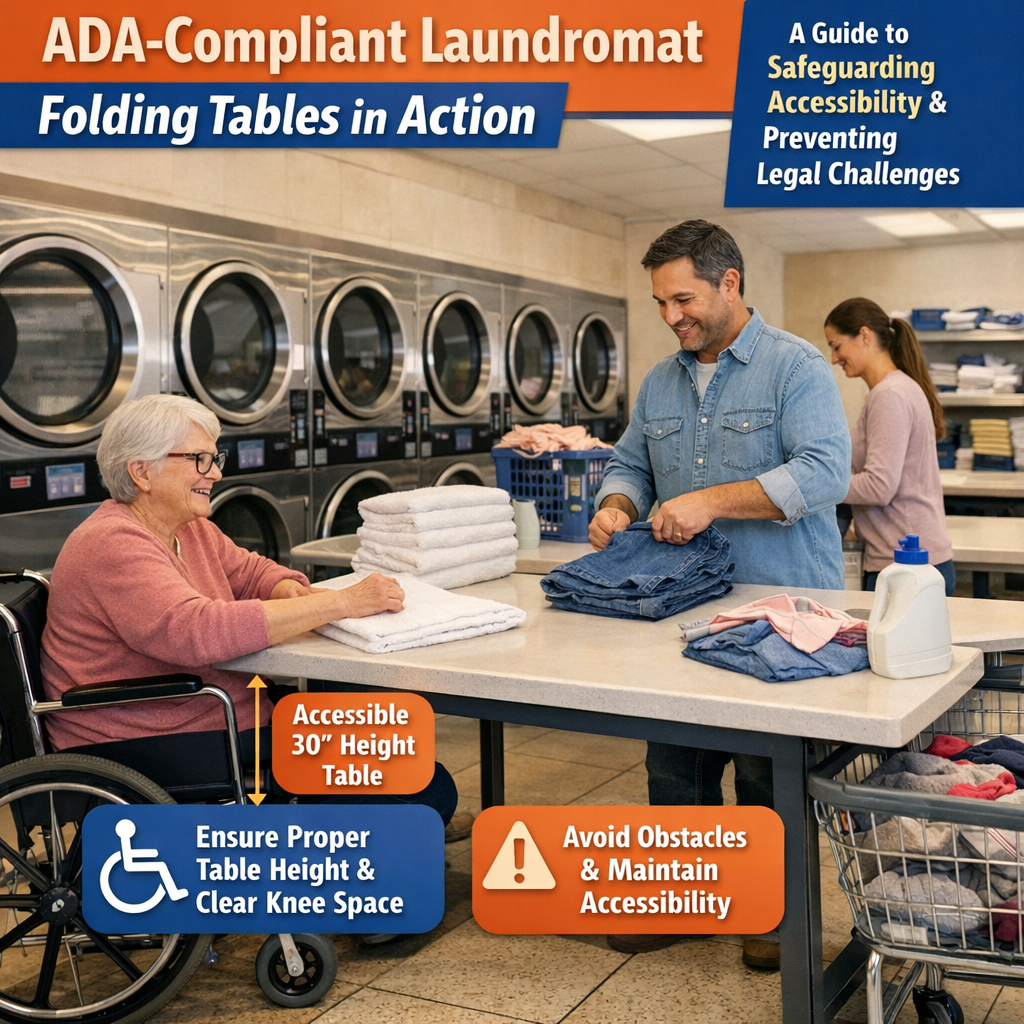
- Ensuring proper height and clearance for folding tables
- Implementing changes effectively
Understanding ADA Requirements
Understanding ADA Requirements
The Americans with Disabilities Act (ADA) was enacted to provide civil rights protection to individuals with disabilities, ensuring equal opportunity and access to public spaces and services. One of the key aspects of ADA compliance is the provision of accessible pathways in laundromats. This section will delve into the specific requirements pertaining to folding tables.
- The height of folding tables should be between 34 inches and 36 inches (86-91 cm) when measured from the floor to the top of the table surface.
- Clearance underneath the table must be at least 30 inches (76 cm).
- Folding tables must have a stable, level surface that does not slope more than 5% in any direction.
- The gap between the table’s surface and the wall or other obstacles should be no more than 3 inches (7.6 cm) to allow for wheelchair maneuverability.
Failure to meet these requirements may result in legal action, as predatory disability lawsuits can be filed against non-compliant businesses. It is crucial to maintain ADA compliance to avoid potential liabilities and ensure equal access to services for individuals with disabilities.
Ensuring Proper Height and Clearance
The Americans with Disabilities Act (ADA) was enacted in 1990 to protect the rights of individuals with disabilities, ensuring equal access to public spaces and services. One aspect of ADA compliance is the Path of Travel standard, which requires that all areas within a laundromat, including folding tables, meet specific height and clearance requirements.
- According to ADA guidelines, laundry facilities must provide a clear floor space of at least 36 inches wide by 48 inches deep for each folding table. This ensures that individuals using wheelchairs or other mobility devices have enough room to maneuver comfortably.
- In addition to the width and depth requirements, the height of folding tables must be between 28 inches and 34 inches from the floor. This allows individuals with visual impairments or those using service animals to easily access the table.
- Proper clearance around folding tables is also crucial for accessibility. There should be at least 36 inches of clear space on all sides of the table, allowing wheelchair users and others with mobility impairments to approach and use the table safely.
By ensuring that your laundromat’s folding tables meet these height and clearance requirements, you can help prevent predatory disability lawsuits and provide a welcoming environment for all customers. Maintaining ADA compliance not only demonstrates a commitment to inclusivity but also helps protect your business from potential legal action.
Evaluating Folding Table Accessibility
Evaluating Folding Table Accessibility
- First and foremost, it is crucial to understand the Americans with Disabilities Act (ADA) requirements for folding tables in laundromats. The table height must be between 28 inches and 34 inches (0.9m – 1.2m), measured from the floor to the top of the table.
- Additionally, there should be at least 7 inches (18cm) of clearance under the table. This ensures that wheelchair users can access the folding table comfortably.
- Furthermore, it is essential for laundromats to provide adequate space around the folding tables so that people with mobility impairments can maneuver their wheelchairs or other assistive devices.
- The folding tables should also have a stable and level surface. This can be achieved by regular maintenance and cleaning of the area, ensuring that there are no tripping hazards or loose items that could cause accidents.
Implementing Compliance Measures
Implementing Compliance Measures
To ensure your laundromat folding tables meet federal ADA standards, follow these steps:
- Maintain a clear and unobstructed path of travel: The path leading to your folding table should be wide enough for a wheelchair to pass through comfortably. Measure at least 36 inches (29-41 inch clearance is required).
- Properly space folding tables: Leave ample space between folding tables so that people using mobility devices can easily navigate around them.
- Ensure adequate height and clearance for folded tables: When a table is folded up, the top surface should be at a height of no more than 5 feet (60 inches) above the floor. There must also be a clear space of at least 36 inches beneath the table when it’s in the folded position.
- Install anti-slip surfaces: Use non-slip materials on the tables and surrounding flooring to prevent accidents caused by wet surfaces or spills.
Conclusion
Conclusion:
In conclusion, ensuring that your laundromat folding tables meet the federal ADA standards is not only a legal requirement but also an act of social responsibility. By providing an accessible and safe environment for all customers, you are fostering an inclusive atmosphere that promotes dignity and respect for all individuals.
- Adopting appropriate height and clearance measurements for your laundromat folding tables can significantly reduce the risk of predatory disability lawsuits.
- Regularly inspect and maintain your laundromat equipment to guarantee compliance with ADA guidelines, thereby preventing potential legal issues and ensuring a positive customer experience.
We urge all laundromat owners and operators to familiarize themselves with the federal ADA standards and take proactive steps in updating their establishments accordingly. By doing so, you are not only safeguarding your business but also making a meaningful difference in the lives of countless customers who rely on accessible facilities.
Leave a Reply